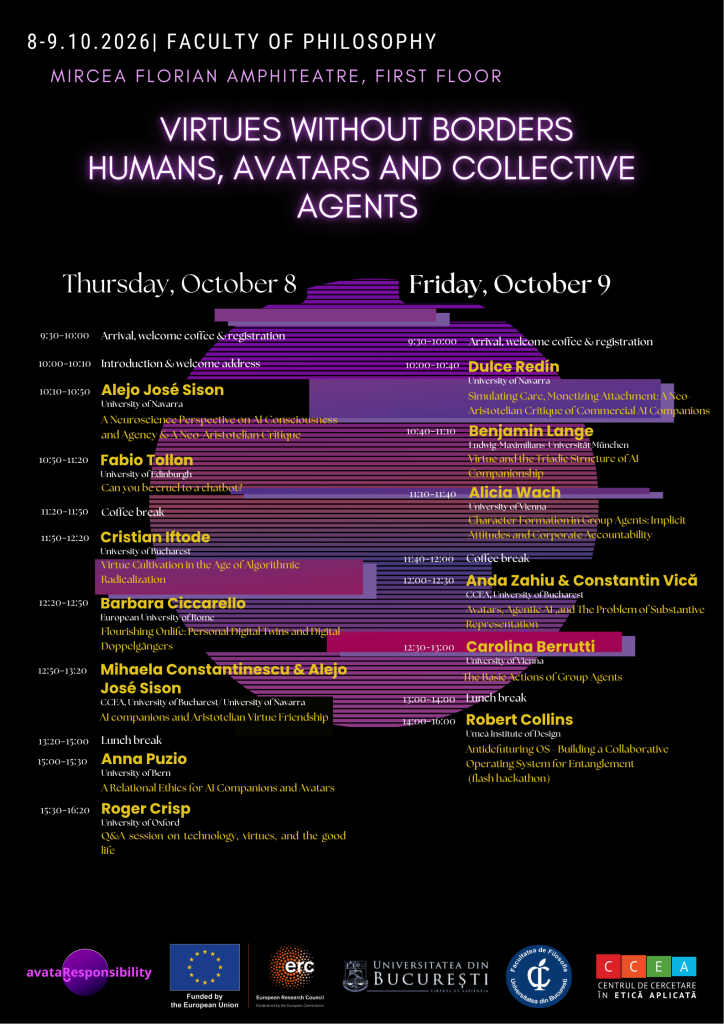
Day 1: Thursday, October 8
09.30 – 10.00: Arrival, welcome coffee & registration
10.00 – 10.10: Introduction & welcome address
10.10 – 10.50: Alejo José Sison (University of Navarra): A Neuroscience Perspective on AI Consciousness and Agency & A Neo-Aristotelian Critique
10.50 – 11.20: Fabio Tollon (University of Edinburgh): Can you be cruel to a chatbot?
11.20 – 11.50: Coffee break
11.50 – 12.20: Cristian Iftode (University of Bucharest): Virtue Cultivation in the Age of Algorithmic Radicalization
12.20 – 12.50: Barbara Ciccarello (European University of Rome): Flourishing Onlife: Personal Digital Twins and Digital Doppelgängers
12.50 – 13.20: Mihaela Constantinescu (CCEA, University of Bucharest) & Alejo Sison (University of Navarra): AI companions and Aristotelian Virtue Friendship
13.20-15.00: Lunch break
15.00 – 15.30: Anna Puzio (University of Bern): A Relational Ethics for AI Companions and Avatars
15.30 – 16.20: Roger Crisp (University of Oxford): Q&A session on technology, virtues and the good life
18.30: Conference dinner for speakers
Day 2: Friday, October 9
09.30 – 10.00: Arrival, welcome coffee & registration
10.00 – 10.40: Dulce Redín (University of Navarra): Simulating Care, Monetizing Attachment: A Neo-Aristotelian Critique of Commercial AI Companions
10.40 – 11.10: Benjamin Lange (Ludwig-Maximilians-Universität München): Virtue and the Triadic Structure of AI Companionship
11.10 – 11.40: Alicia Wach (University of Vienna): Character Formation in Group Agents: Implicit Attitudes and Corporate Accountability
11.40 – 12.00: Coffee break
12.00 – 12.30: Anda Zahiu & Constantin Vică (CCEA, University of Bucharest): Avatars, Agentic AI and The Problem of Substantive Representation
12.30 – 13.00: Carolina Berrutti (University of Vienna): The Basic Actions of Group Agents
13.00 – 14.00: Lunch break
14.00 – 16.00: Robert Collins (Umeå Institute of Design): Antidefuturing OS – Building a Collaborative Operating System for Entanglement (flash hackathon)
Keynote and Guest Speakers
Roger Crisp (Faculty of Philosophy, University of Oxford and The Uehiro Oxford Institute)
 Roger Crisp is the Director of Uehiro Oxford Institute and Professor of Moral Philosophy at University of Oxford. Roger studied Literae Humaniores at Oxford, and then took the B.Phil. and D.Phil. under the supervision of J.L. Ackrill, Jonathan Glover, James Griffin, Michael Lockwood, Derek Parfit, Joseph Raz, Alan Ryan, and David Wiggins. As well as being Director of the Uehiro Oxford Institute, he is Professor of Moral Philosophy in the Faculty of Philosophy, University of Oxford, and Uehiro Fellow in Philosophy at St Anne’s College, Oxford. He held the Findlay Visiting Professorship at Boston University in 2010-11. He served as editor of Utilitas and for several years was an associate editor of Ethics. He was a Delegate of Oxford University Press for over a decade. In 2017-18, he was President of the Mind Association, and has given the Lindley Lecture (University of Kansas, 2018), the Parcells Lecture (University of Connecticut, 2022), and the Cottingham Lecture (University of Reading, 2024). His main research interest is ethics, especially normative ethics, the history of ethics, and practical ethics. He continues to work in other areas of philosophy, including ancient philosophy and political philosophy. He has published monographs on J.S. Mill (1997), Henry Sidgwick (2015), and the British moralists (2019), as well as Reasons and the Good (2006), a defence of various Sidgwickian positions in normative ethics. He has edited a number of collections, including the Oxford Handbook of the History of Ethics, and has translated Aristotle’s Nicomachean Ethics for Cambridge University Press.
Alejo José G. Sison (University of Navarra)
 Alejo José G. Sison is professor of Business Ethics at the University of Navarre. He was president of the European Business Ethics Network (EBEN) from 2009 to 2012, In 2019, he was elected to the board of the Society for Business Ethics and was president from 2022-2023. He ranks among the top 2% of the world’s researchers in Applied Ethics and Business and Management. In 2025-2026, he was on sabbatical at the Gabelli School of Business at Fordham University, writing his latest book, “How AI Can Enable the Virtues” (Cambridge University Press, forthcoming).
Dulce M. Redín (University of Navarra)
 Dulce M. Redín is Full Professor at the University of Navarra, Spain. Her research focuses on virtue ethics, human-centered AI, and the ethical governance of artificial intelligence, with particular attention to human flourishing and the common good. She is a member of the European Commission’s AI Act Advisory Forum and Associate Editor of Business and Society Review.
Robert Collins (Umeå Institute of Design)
 Robert Collins is an interdisciplinary artist/researcher/designer who utilises available and emerging technologies to understand, ground and reify society’s relationship with complex systems. Combining artistic research and design practices, he assembles critical interactive artefacts as ways to facilitate conversation, subvert assumptions and challenge our relationship with technology and the artificial.
Currently based between Ireland and Sweden, Robert is completing his PhD project on Antidefuturing as a practical and philosophical approach for designing interfaces in the new paradigm of socio-technical entanglement. His research begins with repair as a value system for agency, followed by tactics of agonistic pluralism for interaction, and wrapped in a cross-disciplinary philosophy, and practice, for keeping futures open and contestable.
In previous lives he has been an art installer, exhibition producer, musician, IT manager, fabricator and low-level tree surgeon.
Cristian Iftode (University of Bucharest)
 Cristian Iftode is a Professor and PhD Supervisor at the Faculty of Philosophy, University of Bucharest, where he serves as the Head of the Department of Practical Philosophy and the History of Philosophy. He teaches courses on ethics, philosophical therapy, aesthetics, and contemporary philosophy. He has published numerous studies in edited volumes and prestigious scholarly journals, both in Romania and abroad (including The Journal of Value Inquiry, The New Bioethics, Phenomenology and the Cognitive Sciences, AJOB Neuroscience, Ingenium, and Public Reason). His authored books include: Aristotel. Problema analogiei şi filosofia donaţiei [Aristotle: The Problem of Analogy and the Philosophy of Donation] (University of Bucharest Publishing House, 2015), Viața bună. O introducere în etică [The Good Life: An Introduction to Ethics] (Trei, 2021), Filosofia ca mod de viaţă: Sursele autenticităţii [Philosophy as a Way of Life: Sources of Authenticity] (Trei, 2022, 2nd edition), Mintea de pe urmă. Breviar de filosofie practică [In Hindsight: An Outline of Practical Philosophy] (Trei, 2025), Foucault and the Practice of Truth [Foucault and the Practice of Truth] (Trei, 2026). He is a member of the Center for Research in Applied Ethics and a founding member of the Center for Research in the History of Philosophical Ideas at the University of Bucharest. A frequent public speaker, he regularly organizes practical philosophy workshops and maintains a consistent presence in cultural publications, aiming to demonstrate the relevance of philosophy to everyday life.
 Anna Puzio (University of Bern and “Ethics of Socially Disruptive Technologies” – ESDiT)
Dr. Anna Puzio is a philosopher and ethicist of technology based in Vienna and Bern. Her research focuses on philosophical anthropology, identity, relationships, artificial life, new materialism, posthumanism, and environmental ethics.
Benjamin Lange (Ludwig Maximilians University of Munich and the Munich Center for Machine Learning)
 Benjamin Lange leads a junior research group on the ethics of AI based at the Ludwig-Maximilians-Universität München and the Munich Center for Machine Learning (MCML). He is a Research Associate at the Oxford Uehiro Institute for Practical Ethics, and a member of the Center for Ethics and Philosophy in Practice (ZEPP) at LMU. In the past, he was a Visiting Researcher in the Responsible Innovation and AI Ethics Team at Google and a Visiting Fellow at the University of Hamburg. His research focuses on the ethics of AI and technology, normative and practical ethics, and business ethics.
 Fabio Tollon (BRAID – Bridging Responsible AI Divides -program, University of Edinburgh)
Fabio is a philosopher of technology with interests in the ethics of AI, moral responsibility, and free will. He is a teaching fellow at the department of philosophy at the University of Edinburgh, a research fellow at the unit for the ethics of technology at Stellenbosch University and a research associate at the Centre for Artificial Intelligence Research (CAIR) at the University of Pretoria. He is also part of the management team of the UNESCO Chair in AI for Community Resilience at the University of Pretoria.
Alicia M. Wach (University of Vienna)
 Alicia Wach is a PhD candidate at the University of Vienna, working on the FWF-funded project The Ethics of Blaming and Praising Group Agents. She is trained as an environmental scientist and holds Master’s degrees in Ethics of the Environment and the Economy and in Sustainability Studies from Kiel University, Germany. Alicia has worked at the Potsdam Institute for Climate Impact Research (PIK) on international capacity building.
Her research lies at the intersection of ethics and social ontology, focusing on the attribution of responsibility to group agents. She is particularly interested in interdisciplinary approaches to philosophical research and in exploring how philosophical work on responsibility can inform policy and practice.
 Barbara Ciccarello (European University of Rome)
Barbara Ciccarello is a PhD student in Moral Philosophy at the European University of Rome, where she also assists with teaching bioethics. Her research explores biotechnological moral enhancement, with particular attention to its implications for human flourishing and the development of virtue. She is a member of Aretai, an interuniversity research group devoted to virtue ethics. Her broader interests include the ethics of human enhancement and artificial intelligence from a virtue-ethical perspective.
Carolina Berrutti (University of Vienna)
 Carolina Berrutti is a PhD candidate at the University of Vienna working under the FWF project “The Ethics of Blaming and Praising Group Agents”. She holds a bachelor’s degree in Humanities, a bachelor’s degree in Translation Studies, and a master’s degree in Philosophy. She is currently researching topics at the intersection of Social Ontology, Philosophy of Action, and Collective Ethics.
Mihaela Constantinescu (Research Centre in Applied Ethics, University of Bucharest)
 Mihaela Constantinescu is lecturer at the Faculty of Philosophy, University of Bucharest, Romania, and executive director of the Research Centre in Applied Ethics (CCEA). Her research areas include virtue ethics, business ethics, Human-Robot Interaction, and AI ethics, with a focus on the normative interplay between the concepts of moral responsibility and moral agency in relation to individuals, organisations, and AI systems. Her articles were published in journals such as Ethics and Information Technology, Philosophy & Technology, International Journal of Social Robotics, Journal of Business Ethics. She is co-author of the book “Institutionalizing ethics: mechanisms and instruments” (in Romanian).
Mihaela is the Principal Investigator of the ERC avataResponsibility project. Her scientific focus is on developing a normative framework for agency and moral responsibility in emergent avatar communities.
Constantin Vică (Research Centre in Applied Ethics, University of Bucharest)
 Constantin Vică teaches courses at the Faculty of Philosophy, University of Bucharest, on ethics and politics of new technologies, the philosophy of history – the philosophy of the future, digital culture, etc., and is a researcher at the Research Center in Applied Ethics. He has co-authored articles in Science and Engineering Ethics, Ethics and Information Technology, Philosophy & Technology, International Journal of Social Robotics, Frontiers in Robotics and AI, Journal of Bioethical Inquiry, Philosophical Psychology, Phenomenology and the Cognitive Sciences, Topoi, etc. In 2019, he co-edited the volume Vremuri noi, vremuri vechi. Jurnal 2007–2013 by Mihail Radu Solcan. In 2023, he published Civilizație algoritmică și viața în lumea digitală (Algorithmic Civilization and Life in the Digital World) with the University of Bucharest Press.
Anda Zahiu (Research Centre in Applied Ethics, University of Bucharest)
 Anda Zahiu is an Assistant Professor at the Faculty of Philosophy, University of Bucharest, and a member of the Research Centre in Applied Ethics. She has a background in moral and political philosophy. Anda’s research interests include new and emerging technologies, with a particular focus on Virtual Reality and digital avatars.




 Venue: Faculty of Philosophy, University of Bucharest, 8 & 9 October 2026